Traditional Epiphany House Blessing-2026

The visit from the Wise Men blessed the home of the Holy Family because they came in humility to honor and pay homage to the Christ Child and because they were the first to not only seek Jesus, but also to recognize Him as the Messiah.

The Epiphanytide practice of household blessing serves to protect Christian homes from evil spirits until the next Epiphany Day, at which time the custom is repeated.

Please contact your Chaplain, Fr Young if you would like to have your house scheduled to be blessed this Epiphanytide.

See: https://www.virgosacrata.com/epiphany-home-blessing.html

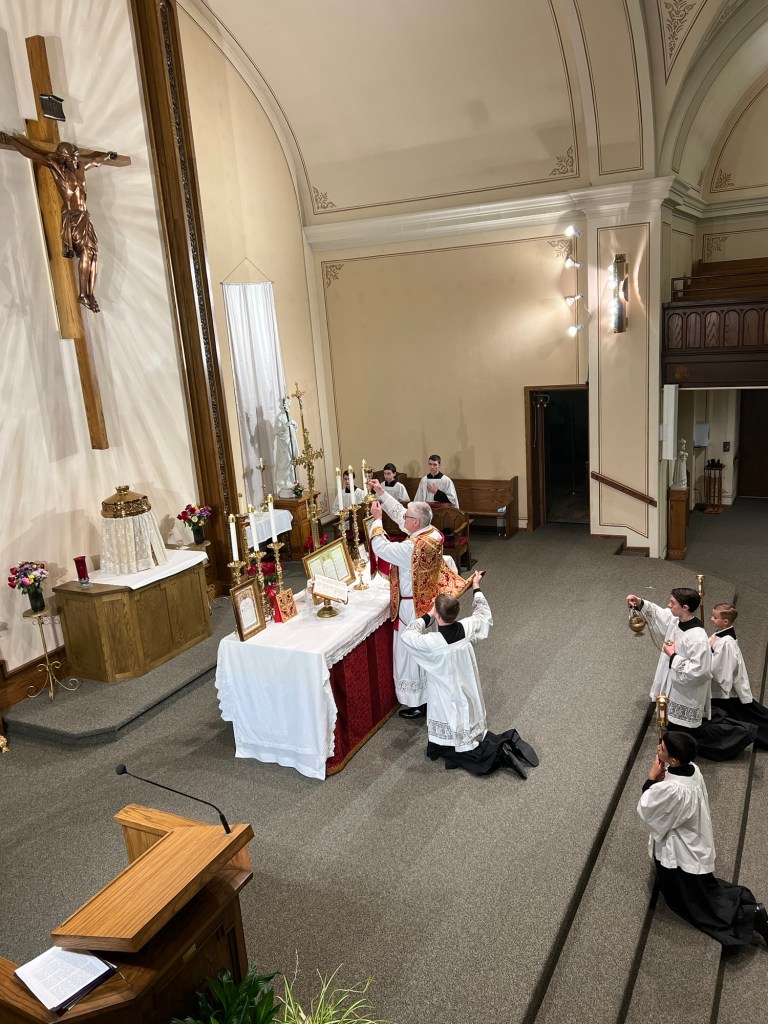
12:05pm, Tuesday 6 January- Feast of the Epiphany of the Lord

Davenport, Holy Family: Low Mass with hymns. Confessions begin 11:15am. Rosary (must) begin at 11:25.

Epiphany Salt and Water and Chalk will begin being blessed at 11:45pm sharp. (You may bring your salt and water to be blessed early, Sunday or Monday)

Homily with be preached following Mass to the benefit of those faithful who need to return to office or shop.

Monday, 29 December- Day V in the Octave of Christmas: St Thomas a Becket, martyr

No Adoration or Mass Today

 Thomas à Becket was murdered in Canterbury Cathedral on December 29th, 1170, less than a month after he had returned from six years of exile in France, where he had been driven by a long persecution at the hands of King Henry II of England. The murder was followed by a wave of revulsion throughout Europe, which did much to promote the reforms within the Church that St Thomas had died to defend. He was canonized by Pope Alexander III, who had received him in audience during his exile just over two years after his death, in no small measure because of the innumerable miracles that took place at his tomb.

The following piece is one of the earliest known musical compositions that refers to St Thomas, and very cleverly associates him the Holy Innocents, whose feast is kept the day before his; England is likened to Rama, King Henry to King Herod, and Thomas to the first-born sons whom Herod killed. France then becomes Egypt, and since Egypt was also the place of the exile of the Patriarch Joseph, St Thomas is called “the Joseph of Canterbury.” The implication of this is, of course, that just as Christ’s exile delayed His unjust death, so did that of St Thomas.

https://youtu.be/c30K1rQsaiI?si=4TgQfeXCs_YmkcuD

Lamentation sounds forth in Rama, as the “Rachel” of England weepeth. A new Herod gives her unto ignominy. Behold the first-born of the realm, the “Joseph” of Canterbury, as if he were sold, dwells in the “Egypt” of France. (On the YouTube channel that posted this, the first word of the 7th line is correctly transcribed “exulat,” but the singers clearly say “exsultat.” Thanks to Dr Jeffrey Morse for bringing this to my notice. UPDATE: Jesson Allerite has linked a source in the combox that gives a better reading for that line, “exsul, ac si sit venditus – an exile, as if he had been sold.”) 

Here is a very early reliquary of St Thomas, made at Limoges, France in the 1180s, showing the scene of his assassination in the lower part, his burial and the ascent of his soul into heaven in the upper. Devotion to him was incredibly powerful in the Middle Ages and afterwards, especially in England until the Reformation. (It is to his shrine that the pilgrims of Chaucer’s Canterbury Tales are making their way.) More than 40 such reliquaries are still extant.

GREGORY DIPIPPO https://www.newliturgicalmovement.org/2015/12/st-thomas-of-canterbury.html?m=1