Holy Family, Davenport: 10:15 Confessions, 10:40 Rosary, 11:00 Low Mass. Holy Face devotion; Fellowship Meal after Mass
St Patrick, Iowa City: 2:10, Confessions, 2:30 Low Mass
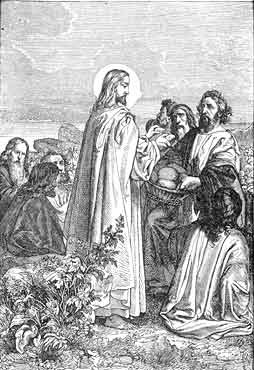
Why did Christ say: ‘I have compassion on the multitude?’
Because of His mercy and goodness to man, as well as to prove that which He taught on another occasion, (Matt. VI. 33.) that to those who seek first the kingdom of God and His justice all other things will be added, without asking; for none of the multitude asked Christ for food, and yet He provided for all.
And He blessed them. (Mark VIII. 7.) Why?
Seduced by Satan, the first man violated the holy is command of God, and by his sin brought upon himself and his habitation the curse of divine wrath. (Gen. III. 17.) Man was made by God, and therefore subject: to Him, but was himself master of all created things. .
After the sin of disobedience, however, all creation revolted against him: the animals fled from him, the fields yielded only thorns and thistles, the herbs became poisonous to him, or refused him their former wholesome power. Innumerable evils followed, all men and even the whole earth suffered from them; the devil drew both into his sphere and made them his servants, and this evil spirit now made use of created ,things to divert man altogether from God and to cause his eternal ruin.
But God decreed that man and earth should not remain in this condition: Christ, the Son of God, came upon earth, redeemed it from the bonds of Satan, and gave all men the power to become once more God’s children. The devil was conquered by the cross, but not slain; man and the, earth were indeed taken from his dominion, but not from his influence; for he even now, as the apostle Writes, goes about like a roaring lion, seeking ,whom he may devour, (I Peter V. 8.); and as he used the forbidden fruit in paradise to seduce man, he now uses the created things of the earth to tempt man, and, make him his servant. Man and all creation had to be drawn from this pernicious influence, to be liberated from the bondage of corruption and be brought to the freedom of the children of God. (Rom. VIII. 19.)
This is done in the Church, to which Christ entrusted the power of binding and loosing, and gave the work of sanctifying through the Holy Ghost, by means of blessing and consecrating. By virtue of the merits of Christ, and with the assistance of the Holy Ghost, the Church, or the priest in her name, therefore blesses and consecrates persons as well as other created things which they are to use, or which she is to apply to the service of God.
In this the Church follows the example of Christ and the Apostles. Jesus embraced children and laid His hands upon them, blessing them; (Mark X. 16.) He blessed bread and fishes, the food of thousands; blessed breed and wine at the last supper; (Matt. XXVI. 26.) was recognized by the disciples in the blessing of bread; (Luke XXIV. 30.) blessing the disciples He ascended into heaven; (Luke XXIV. 51.) by His command the apostles wished peace to every house into which they stepped; (Matt. X. 12, 13.) and St. Paul expressly says, that every living thing is sanctified by prayer and the word of God. (I Tim. IV. 5.)
Following the example and command of Christ the Church also introduced blessings and benedictions which were prefigured in the Old Law. God commanded the priests to sanctify and to consecrate whatever was to belong to His service, (Levit. VIII.) and the Old Law is full of blessings and consecrations which had to be used by the priests; (Exod. XXIX. 36.; XXX. 25.; XI. 9.) and if persons and things used for God’s service were to be blessed, how much more so in the. New Law which in place of the type, contains the reality and truth The testimony of Scripture is confirmed by all the holy Fathers, and by the constant practice of the Church which has received from Christ, the power to bless and to consecrate. Fr Leonard Gofine

