It’s ‘-gesimatide’, ya’ll !

SEASON OF SEPTUAGESIMA

DOCTRINAL NOTE. – The Season of Septuagesima, with which the Paschal cycle begins, starts at once on the theme which is to form the subject of the liturgy of Lent and Eastertide – the passage of humanity from the state of decadence and slavery in which it had been placed by sin to that of being raised up and set free which only God can grant it.

The liturgy begins by introducing us to the depths of man’s fallen state. At Matins the study of the Old Testament begins once again in order to make us fully aware of our wretched state. On the first Sunday comes the assertion of original sin and the fall of Adam (Septuagesima); then the lamentable account of the fatal consequences of these events with the malice of men and the flood which is their punishment (Sexagesima). Abraham’s action in preparing to sacrifice his son foreshadows the sacrifice which God was to require of His own Son, for the expiation of the sins committed by humanity (Quinquagesima).

At Mass, after a heartfelt but confident reminder of the help of God (Introit of the three Sundays) the Epistles of St. Paul are an urgent invitation to faithfulness and effort, as well as to charity, whose praises he sings admirably. Then come the Gospels, all filled with the great hope of salvation: the parable of the workers in the vineyard shows that redemption extends to all ages; that of the sower, that it will reach every man who is open to receive the word of God; the cure of the blind man of Jericho, which follows the prediction of the passion, is already a heralding of the passage from darkness to light. This liturgy in which the wretchedness and extent of sin call for the redemption which is foretold forms an admirable introduction to Lent and the liberation of Easter.

LITURGICAL NOTE- The names Septuagesima, Sexagesima and Quinquagesima denote not the week but the period of ten days during which each of these Sundays falls; in Latin it is expressed more accurately as Dominica in Septuagesima, as Dominica in Sexagesima and Dominica in Quinquagesima. This pre-Lenten mini-season is a prelude to Lent of which it foreshadows the austerity and penitential character. Fasting is not yet imposed but the colour of the vestments is already violet.

Septuagesima Sunday- Driven out from the earthly paradise where God had placed him, man is profoundly aware of his wretched state and implores divine mercy.

Suffering and death, the consequences of sin, weigh upon us. It is under the weight of our wretchedness that, taken in charge by the Church, we send up our cries for help to God. Great is man’s distress. And it would be without remedy had not God, directly after the fall of our first parents, promised us a Saviour; it is to Him that the Church turns our eyes.

With her we set out for Easter. At the same time that she makes us fully aware of our wretchedness she infuses into our souls all the strength of Christian hope founded on faith in Christ, our Redeemer.

But we must accept the conditions of our redemption. Salvation is a gratuitous gift, won for us by Christ, but only on the condition that, responding to the divine invitation, we are willing to set to work in our Father’s vineyard.

On the idea that “God gives grace to whom He wills”: Titus 3.4-7 and Timothy 1.9 and the whole elaboration of the theme in Romans 9 to 11 (the problem of the rejection of the Jews in favour of the Gentiles).

The quotations from, among others, Exod.33.19 and Osee 2.1,25. The freedom of choice in the story of Esau and Jacob (Gen. 25.19-28; 27.1-45-Mal. 1.2-3 should be remembered as also in the divine election of David, the youngest of the family (1 Kings 16.1-13) in Jacob’s preference for Ephraim, the last-born of Joseph, rather than for Manasses, his eldest son (Gen.48:1-20). For a really clear understanding of this mystery of grace refer again to the parables of divine love (Luke 15) and also that of the pharisee and the publican (Luke 18.9-14). On this subject see what is said on the 10th Sunday after Pentecost; read also, from the great quantity of passages (so many that not all can be cited), Romans 8, which is a paean of praise for the love of God for us. See also the 15th Sunday after Pentecost (divine mercy) and the feast of the Sacred Heart.

The moral conclusion deriving from the above: since the reward is given equally to all out of pure grace no one has any cause for pride in their own works or worldly advantages (Romans 4.2-8 – 1 Cor. 1.26-31; 3.18-22 – 2 Cor.11.30; 12.5-10 – Ephes.2.8-10 – Philip.3.411).

On Christ’s statement that “the last shall be first”: it should be noticed that it occurs also in the verse immediately preceding this passage at the end of Jesus’ promise to those who have left all to follow Him Matt. 19.21-30, and compare it with 1 Cor.4.9-13 where St. Paul tells us that the apostles are “the last” in the eyes of the world).

Under the inspiration of the liturgy we should read Ps.129 of which a great part occurs in today’s Mass.

BIBLE READING: Genesis 1.1 to 2.3; 2.7 to 3.24; 4.1-16.

St Andrew Daily Missal (1962)

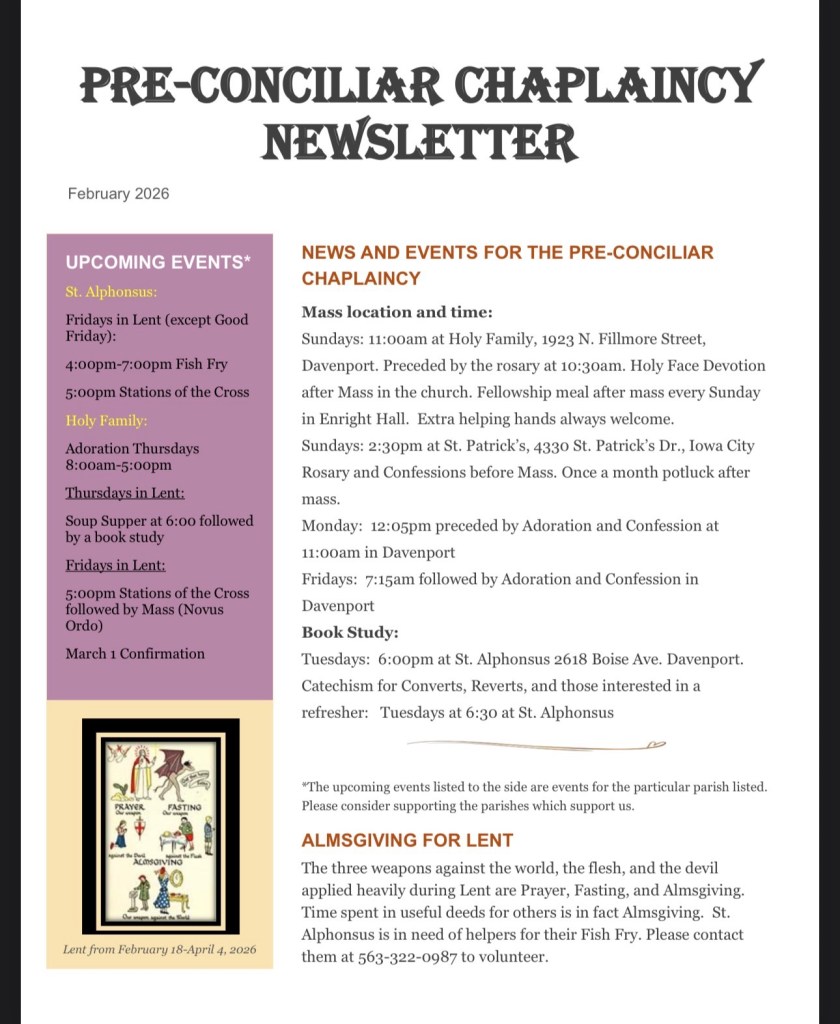
1 February- Septuagesima Sunday

Davenport, Holy Family: High Mass, 11:00am. Confessions & Rosary before Mass; Holy Face devotion & Fellowship Meal in Hall after Mass

Iowa City, St Patrick: Low Mass with hymns, 2:30pm. Rosary & Confessions before Mass. Potluck after Mass.
Today you may bring candles to the sacristy to be blessed tomorrow before Candlemas (11:40am, Monday) You may collect them next Sunday, if you cannot come to Dav on 2 Feb.


Adam and Eve were banished from the Garden of Eden after eating the forbidden fruit, the knowledge of Good and Evil, as recorded in Genesis 3:23. 
 God expelled them to prevent them from also
reaching out and eating from the Tree of Life, v.22, which would have allowed them to live forever in their fallen, sinful state. 
 This act was not merely punishment but a protective measure to ensure that humanity would not eternally exist in a condition separated from God. 

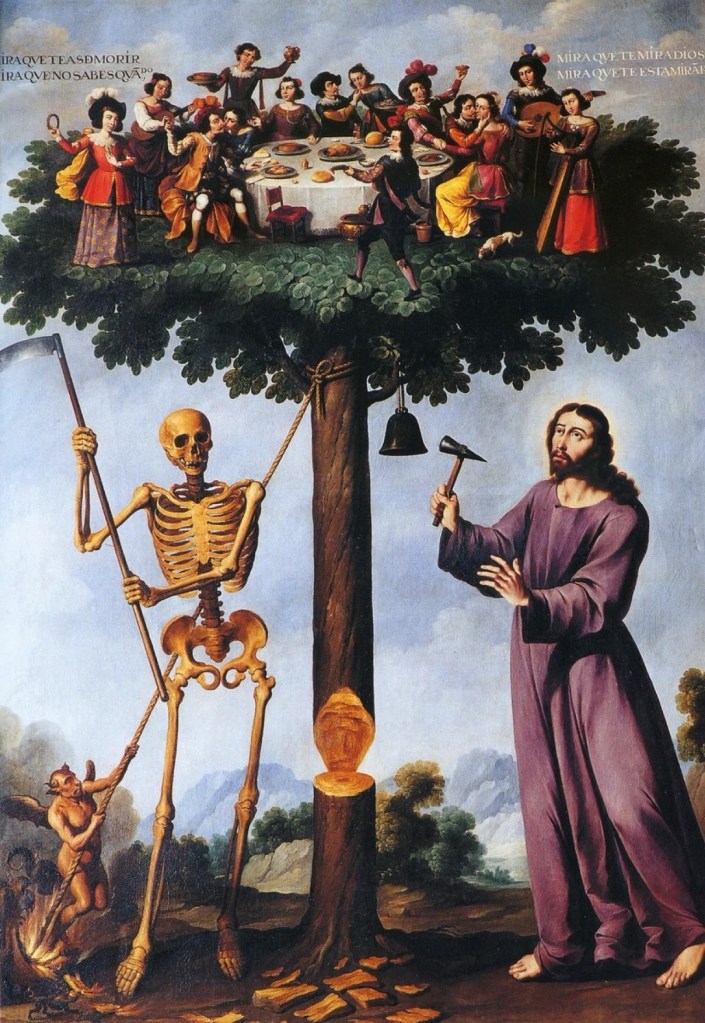
Man in his wretchedness, enchained by death, impiores salvation, for a fery sword forbids his entry into paradise, the Lord’s vineyard, as a result of his first sin and the Serpent’s treachery. Now is the time of labour and suffering, penance and prayer. “Lord, restore us to heaven!”

https://extraordinaryform.org/propers/Septuagesima.pdf

12:05pm, Monday 2 February- Purification of the Blessed Virgin Mary – Candlemas

The blessing and distribution of Candles will take place before Mass, beginning at 11:40am. Then, we process indoors. You may bring candles to be blessed for home use. Potluck lunch afterwards.

https://extraordinaryform.org/propers/0202PurificationAnteMissam.pdf

https://extraordinaryform.org/propers/0202Purification.pdf

https://www.newliturgicalmovement.org/2021/02/a-comparison-of-old-and-new-blessing-of.html?m=1

12:05pm, Monday 19 January- Day within the Church Unity Octave for the unity of the entire Catholic Church

Votive Mass of the Chair of St Peter

https://extraordinaryform.org/propers/0222ChairofStPeter.pdf

Today’s Mass is being offered for the Personal Ordinariate of the Chair of St Peter – the U.S. Anglican Ordinariate jurisdiction: her bishop, priests and lay faithful and the promotion of:

Ordinariate parishes which maintain elements of Anglican liturgy and tradition in their Masses and other worship services, such as Evensong. The ordinariate is under the direct authority (exempt) of the Holy See

The Personal Ordinariate of the Chair of Saint Peter includes more than 40 parishes and missions with 12,000 members in the United States and Canada. It is based in HoustonTexas, with the Cathedral of Our Lady of Walsingham as its principal church.

The liturgy of the ordinariate, known as the Anglican Use, is a form of the Roman Rite with the introduction of traditional English Catholic and Anglican elements. Also called “Divine Worship” or the “Ordinariate Use”, the Mass is celebrated according to Divine Worship: The Missal and the canonical hours according to Divine Worship: Daily Office.

In the early 21st century, a number of bishops from the Church of England and the bishops of the Traditional Anglican Communion (TAC), a global “continuing Anglican” body, independently approached the Holy See seeking some manner of corporate reunion that would preserve their autonomy and their ecclesial structure within the Catholic Church. Many of these bishops were unhappy with changes within the Anglican Church, such as the ordination of female and LGBT priests, and the consecration of same sex marriages.

In response, Pope Benedict XVI promulgated the apostolic constitution Anglicanorum coetibus, permitting erection of personal ordinariatesequivalent to dioceses, on November 4, 2009.

Formation

Pursuant to Anglicanorum coetibus, the Vatican erected three ordinariates over the next three years in countries where interest among prospective Anglican clergy and communities was strongest:

https://en.wikipedia.org/wiki/Personal_Ordinariate_of_the_Chair_of_Saint_Peter